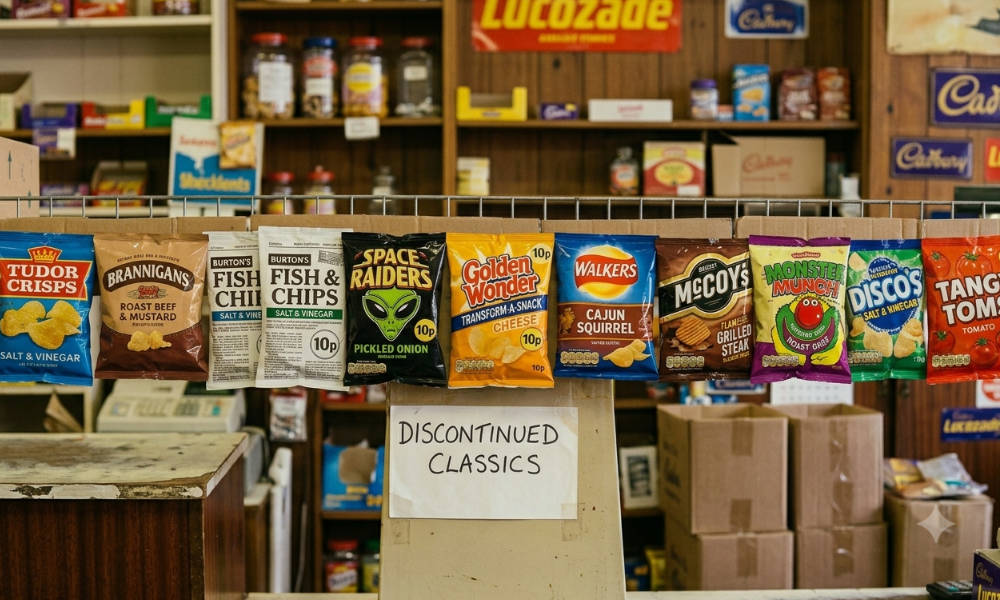
There was a time when the crisp selection wasn’t dictated by the sterile, uniform aisles of a mega-supermarket. If you grew up in the 80s or 90s , the true destination for snacks was the local corner shop, the independent newsagents, or the school tuck shop.
Armed with nothing but a shiny 50p piece and some post-school freedom, you didn’t buy sensible, health-conscious multi-packs for the week ahead. You stood at a wooden counter, staring at a glorious, chaotic wall of crinkly bags hanging from giant cardboard strips, and picked your poison on a whim.
It was a mix of odd shapes, aggressive seasoning, and ideas that barely stuck around long enough to become normal. A packet of crisps often sat next to a can of Top Deck or a bag of penny sweets, and even that small decision felt like part of the day rather than a routine. As supermarkets tightened their grip, the shelves started to look the same everywhere, and the more unusual local stuff slowly disappeared. What faded wasn’t just variety, but the small habits that came with it.
Here is a look back at the UK crisp history people still talk about.
The Defunct Legends
1. Brannigans
Peak era: 1980s to 2020
Often described as the ultimate pub crisp. Thick cut, heavily seasoned, and unmistakably bold.
Flavours remembered:
- Roast Beef & Mustard
- Smoked Ham & Pickle
When KP Snacks discontinued Brannigans in 2020, it marked the end of one of the strongest “grown-up” crisp ranges in the UK. The Roast Beef & Mustard flavour in particular was known for its sharp, sinus-clearing heat and dense crunch.
2. Tudor Crisps
Peak era: 1970s to early 1990s
A strong regional brand, particularly in the North East, before being absorbed into larger ranges.
Flavours remembered:
- Gammon & Pineapple
- Pickled Onion
- Kipper (often recalled, though less widely distributed)
Tudor advertising and branding made a big impression in its time, and it became part of everyday school and corner shop life before disappearing as consolidation took over the market.
3. Burton’s Fish ‘n’ Chips
Peak era: 1980s to 1990s
A tuck shop staple made from crisp-style corn snacks shaped like fish and chips.
Flavour:
- Salt & Vinegar
These came in newspaper-style packaging and were heavily seasoned. They later returned in limited runs, but most people remember the original school-era version as the defining one.
4. Phileas Fogg
Peak era: 1980s to 1990s
Positioned as a more premium, “world-inspired” snack brand before the modern upscale crisp market existed.
Flavours remembered:
- Mignon Morceau
- Punjab Puri
- Tortilla Chips
The branding leaned into travel and sophistication, introducing UK consumers to more heavily spiced and international snack styles before quietly fading as competition increased.
5. Doritos 3D
Peak era: late 1990s to early 2000s
A product of late 90s novelty snacking. Puffed, hollow, three-dimensional triangles with a light, airy crunch.
Flavours remembered:
- Spicy Cheese
- Texas Paprika
Packaged in canisters rather than bags, they disappeared in the mid-2000s, becoming one of those snacks people remember more vividly than they were widely available for.
The Limited Edition Wave
6. Walkers “Do Us A Flavour” series
Released: 2008–2009
A public-voted experiment that produced some of Walkers’ most talked-about limited flavours.
- Cajun Squirrel (2008)
- Builders Breakfast (2009)
Cajun Squirrel became famous for the name alone, while Builders Breakfast aimed for full breakfast flavour in crisp form, with predictable results. Both disappeared shortly after release.
The They Don’t Taste the Same Club
Even the survivors don’t quite land the same way. A quiet shift came when recipes were adjusted across the industry, swapping out saturated fats for sunflower oils. It sounds minor on paper, but it changed how seasoning clings and how it hits, leaving crisps like Discos without that sharp Salt & Vinegar bite that used to feel almost reckless.
Then there’s the Monster Munch debate, which has become part snack history, part pub argument. Pickled Onion claws are still around, but plenty insist they’ve downsized from the oversized handfuls of the 90s lunchbox years. The official line points to perception, bigger hands, smaller nostalgia. But most people remember a stronger crunch and a flavour that didn’t hold back.
7. Monster Munch (Pickled Onion)
Introduced: 1977
Still available, but endlessly debated in terms of size and intensity.
Monster Munch remains tied to school lunchboxes and 90s childhood, with many insisting the original flavour hit harder than modern versions.
8. McCoy’s Flame Grilled Steak
Introduced: 1985
Still on shelves, but often cited in nostalgia discussions about flavour strength.
The debate tends to focus on whether earlier versions had a deeper smoky intensity and heavier seasoning compared with today’s packs.
9. Discos (Salt & Vinegar)
Introduced: 1980s
Famous for an aggressive vinegar hit that defined playground snacking.
While still sharp today, older versions are often remembered as significantly more intense, bordering on overwhelming.
The 10p Tuck Shop Era
The real royalty of that era were the pocket-money staples, where the price mattered almost as much as the flavour. Space Raiders sat right at the centre of it. KP’s alien-shaped corn snacks, usually pickled onion or beef, weren’t just cheap, they advertised it in plain sight, with 10p printed right on the bag like a promise.
If you had just a few pence of loose change left over from buying a comic, you turned to the unsung heroes: Tangy Toms and Chipsticks. These small tomato corn balls and sharp vinegar maize sticks were the ultimate impulse buys, cheap, salty, and tasty.
10. Space Raiders
Introduced: late 1980s
Corn snacks strongly associated with corner shops and pocket money culture.
Flavours:
- Beef
- Pickled Onion
The price point, once printed on the bag, is a key part of its identity. Inflation changed that permanently, marking the end of a very specific era of childhood snacking.
11. Transform-A-Snack
Introduced: 1980s
A novelty snack built around interlocking corn shapes.
Flavours:
- Cheese
- Beef
- Spicy variants
Often remembered as much for the concept as the taste, it blurred the line between snack and toy, especially in school settings.
12. Tangy Toms & Chipsticks
Introduced: 1970s–1980s
Corner shop staples that rarely led advertising campaigns but were always present.
- Tangy Toms: small tomato-flavoured corn snacks with a sweet-savoury profile
- Chipsticks: long maize sticks with a salt and vinegar coating
Both have become less visible in mainstream supermarkets, now more commonly found in discount retailers and multipacks rather than prime shelf space.
The modern crisp aisle is tidier, more curated, and far more predictable. Sweet Chilli, Truffle, Rosemary, all lined up in near-identical bags under carefully managed branding. It works, but it all feels a bit engineered.
What’s missing is the rougher edge that came with the old stuff. The packets that punched you in the nose when you opened them, the odd shapes you had to assemble before eating, and the habit of scraping together coins just to see what was new at the corner shop. It wasn’t polished, but it had a bit more personality than today’s perfectly arranged shelves.